Case study · AI and education
Preluma
An adaptive pre-class learning platform that replaces passive reading with a guided five-step mission, resilient AI assistance, mistake feedback, and actionable class preparation.
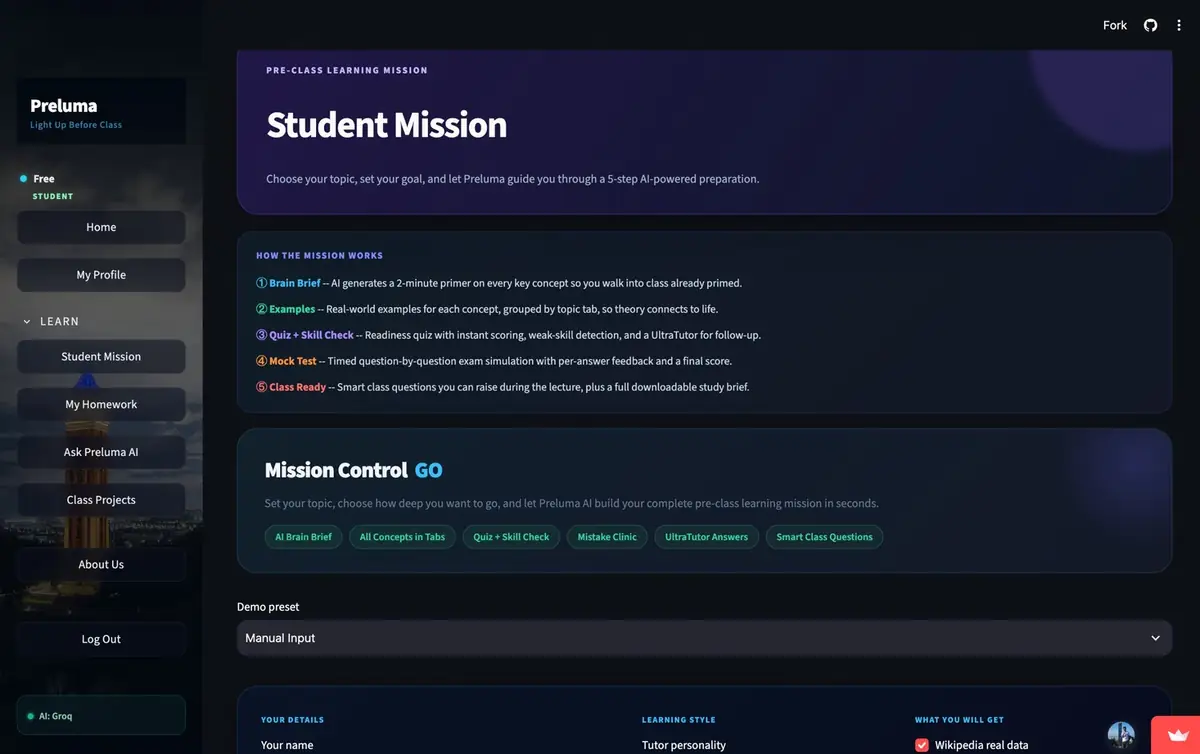
Product demo
From Student Mission to learning insight
A concise visual walkthrough of the documented product flow, created without exposing student records or private educational data.
Silent feature walkthrough · 13 seconds
Interface anatomy
A learning mission students can understand
The interface makes the preparation sequence visible before asking the student to provide details or wait for an AI response.
- 01 · ROLE-AWARE NAVIGATIONThe student journey stays focused
Mission, homework, tutor, and project areas are separated from profile and account actions.
- 02 · VISIBLE LEARNING MODELFive steps before class
Brain Brief, examples, skill check, mock test, and Class Ready questions set a clear expectation.
- 03 · MISSION CONTROLChoice without interface overload
Topic, depth, tutor style, and outputs are configured in one guided starting point.
01 · Problem
Passive reading does not reveal confusion
Textbooks and handouts cannot adapt to what an individual student misunderstands. Without feedback, students may arrive at class having scanned the material but still unsure which concepts matter or what questions to ask.
Preluma turns preparation into an active workflow while keeping the experience available to students through a cloud-deployed interface.
02 · Learning flow
A five-step Student Mission
- Brain Brief: concise AI primer on key concepts
- Examples: concepts connected to real situations
- Quiz and Skill Check with weak-skill detection
- Timed Mock Test with answer feedback
- Class Ready questions and downloadable brief
- Mistake Clinic and selectable tutor personalities
03 · Resilience
AI access that survives provider failure
Free-tier AI endpoints can rate-limit or become unavailable. Preluma integrates eight providers behind a seven-step sequential failover chain with a per-call timeout, allowing the interface to move to another configured provider without changing the student's workflow.
Production data uses Supabase and PostgreSQL with twelve relational tables. A local fallback keeps demos and learning sessions usable when cloud access is unavailable.
Stack
04 · Contribution
My responsibility in the team
My responsibility centered on product direction, the learning workflow, AI behavior requirements, interface decisions, integration review, and structured testing. Across the three-person team, the delivered platform also included the provider layer, authentication, storage, analytics, validation, Wikipedia integration, automated tests, and 29 curated topic packs.
The course required the analytical core to use only the Python standard library. Sorting and searching were therefore implemented by hand, with a test enforcing that constraint.
Explore the documented system
Review the architecture, implementation, tests, and product decisions in the public repository or discuss the project directly.